Human centered AIEnd to endHuman centered researchArchetype developmentOpportunity workshops
Who takes care of the caregiver? From an open brief to an approved service concept
Given an open brief to find a new opportunity in aging, I helped narrow an enormous landscape to one focused problem, built the archetype framework that led to our winning concept, and led the team's responsible AI practice. Leadership approved the concept; I now own the frontend design, user stories, and build architecture.
Client
Fortune 500 Enterprise (Innovation Group)
Role
Service Designer
Team
4 to 5 people · Late 2024 to ongoing
Status
MVP in development, anonymized
The open brief
The client's innovation group came to us with one ask: find a new opportunity inside the broad topic of aging. No predefined user. No predefined solution. No defined scope.
Aging is an enormous space. Before we could design any research, we had to narrow it.
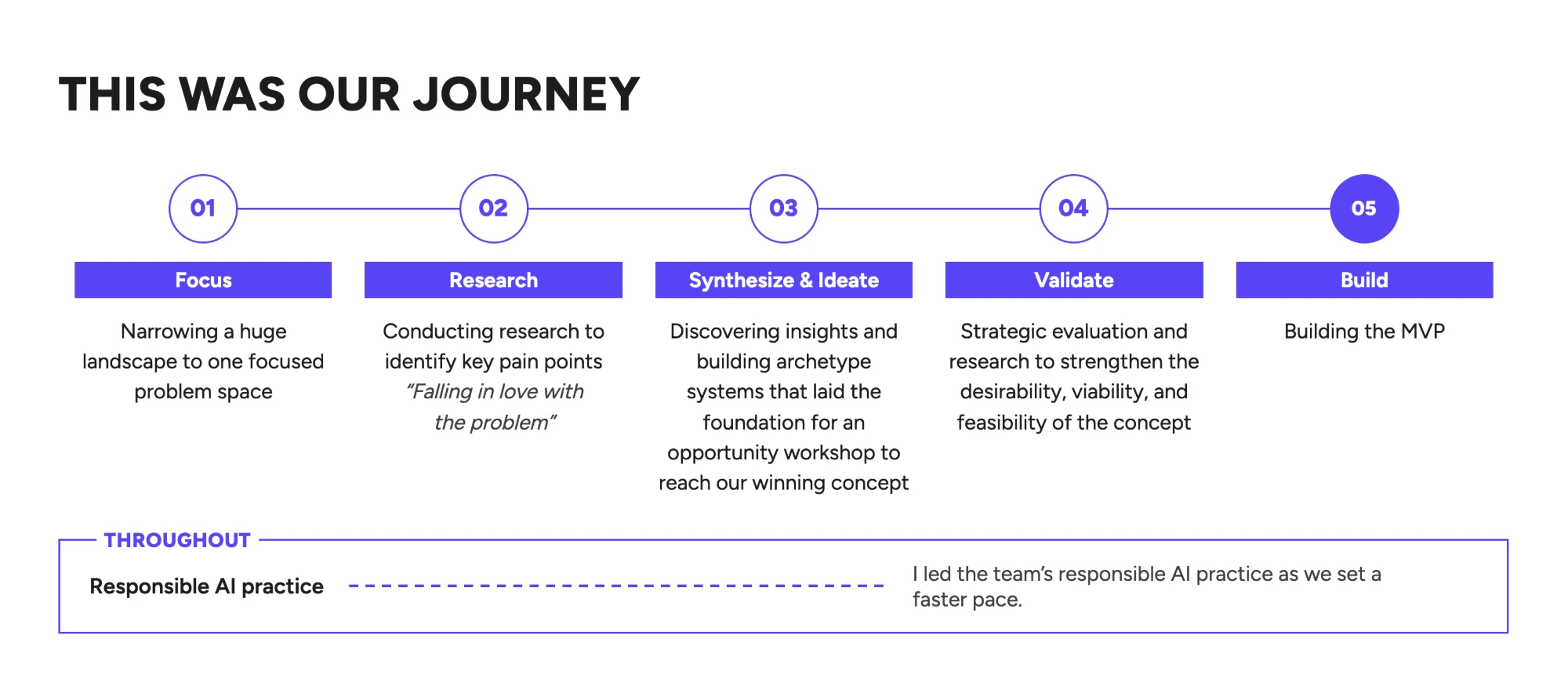
Process overview, from problem framing to MVP
The insight that redirected the brief
I joined one to two months in, while the client's team lead was still working through secondary research on the aging landscape, bringing a fresh point of view to help make sense of what she'd gathered.
From there, we interviewed 15 friends and family members and conducted 16 follow up interviews with aging adults, primary caregivers, and secondary caregivers. One thing became clear fast: caregivers were already stretched thin across every other role they held: parent, employee, friend, community member, before caregiving even entered the picture.
“Age does not determine life stage. Life events do. A health scare, a sudden shift in circumstances, a parent who starts needing you, and someone is in a new stage of life, no matter what their birthday says.”
That reframe is how we chose caregiving. Not the loudest pain point in the room, but the right problem: high value and underserved.
Building the evidence
We interviewed 12 caregivers and care receivers, then went deeper with subject matter experts: academics researching aging and caregiving, a certified nurse, a home care attendant, and people working in elder care.
I shaped who we talked to, what we needed to learn, how we ran the interviews, and how we turned what we learned into insights. Two analogies I introduced ended up carrying the team's final framing:
The iceberg of caregiving
From the outside, everything looks fine. Under the waterline is the burden primary caregivers actually carry.
The boiling frog
Care responsibilities add up so gradually that caregivers don't realize how overwhelming it's become until they're already in it.
“Out of obligation or love, caregivers absorb more and more of an aging parent's life until the weight becomes impossible to ignore: coordinating doctors, managing finances, handling daily care, all while trying to hold their own life together.”
The opportunity was to build something that helps them carry it.
Archetypes that shaped the opportunity workshop
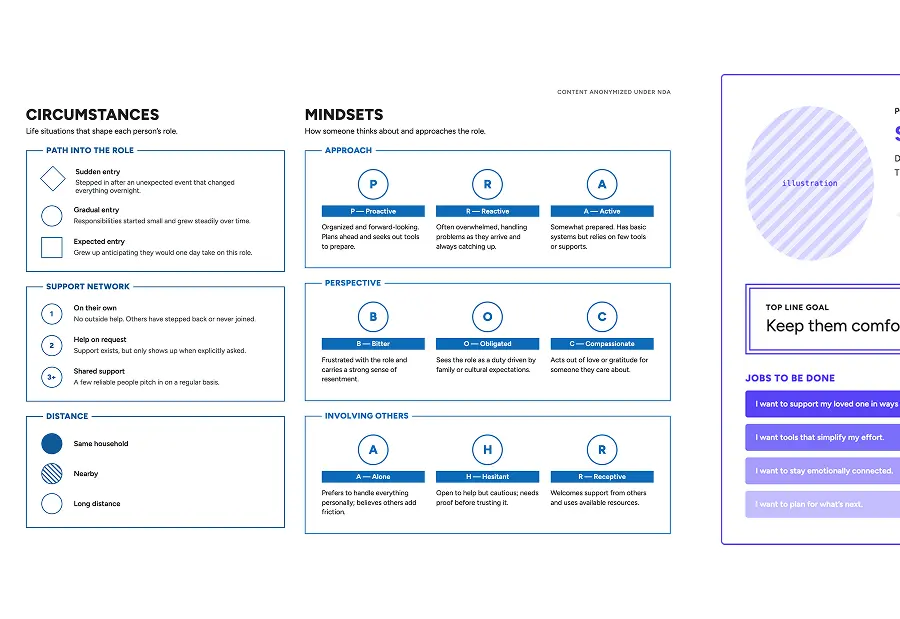
Traditional personas wouldn't have done justice to caregiving's complexity. It isn't just about the caregiver; it includes the care receiver, their relationship, the distance between them, finances, and the daily realities of how care actually gets delivered.
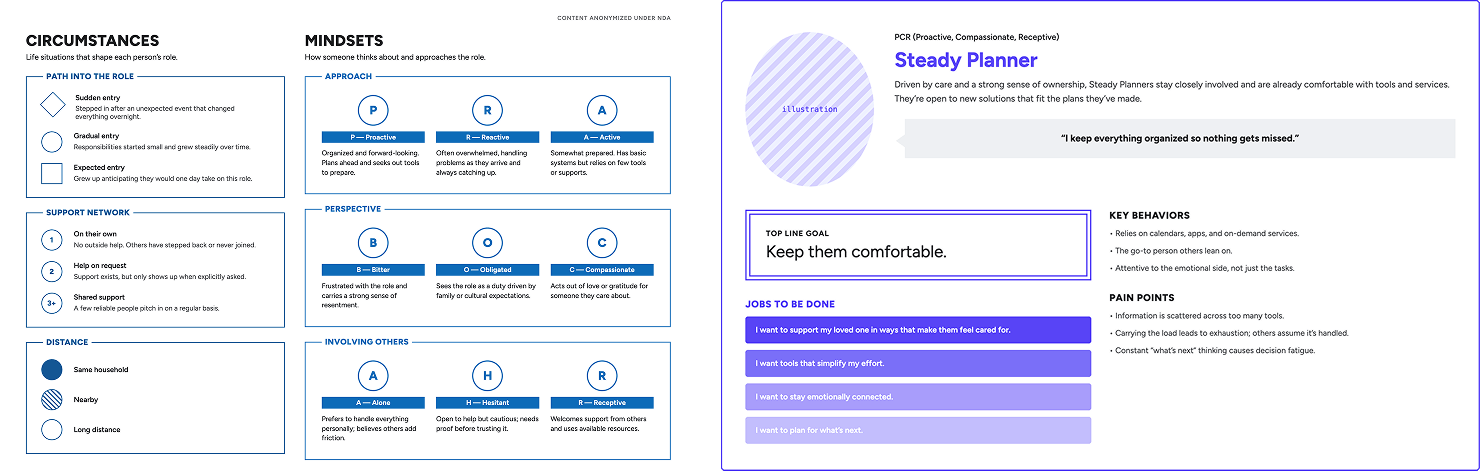
So instead of personas, I built a framework on two layers: circumstances (how someone entered caregiving, suddenly or gradually, alone or with support, living with their parent, nearby, or far away) and mindsets (care style: proactive, reactive, or active; and emotional orientation: obligated or passionate). Each mindset pairing got a short code, like Myers Briggs types, because caregiving combinations aren't a spectrum, they're a matrix.
I went back through every interview, coded each person, and identified which pairings showed up most and where the sharpest design opportunities lived. Each archetype that emerged carried a quote, a topline goal, jobs to be done, key behaviors, and pain points, and became the backbone of the opportunity workshop. Every concept we ideated, and every decision about what to build, ran through them first.
Content anonymized under NDA
From concepts to an approved service
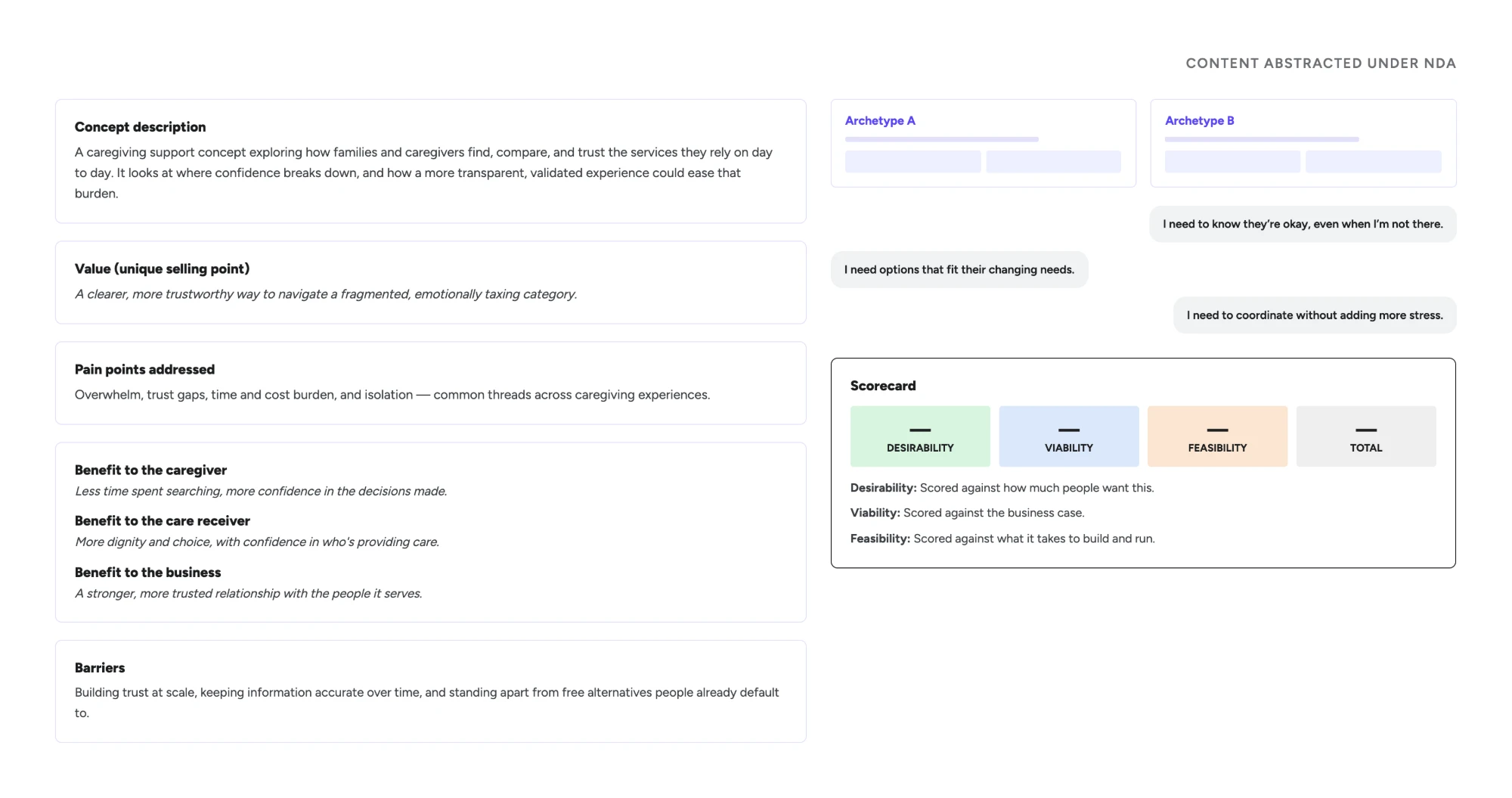
Between the workshop and our own ideation sessions, we had far more concepts than we could build. We scored every candidate against experiential needs, archetype needs, and desirability, feasibility, and viability: narrowed to four finalists, then landed on a direction that combined elements of several rather than crowning one.
From there, it became full service design: front stage and back stage service blueprints, a value exchange map, and Wizard of Oz mock screens to see how people actually felt about the concept before we committed to building it. We also mapped our critical uncertainties up front, so later we could check whether we'd answered the questions that mattered, not just the easy ones.
I facilitated interviews to gather reactions and refine the concept, and owned the visual storytelling for reports and leadership presentations. Leadership approved the concept, and I now own what comes next: the frontend design, the user stories, and the architecture of the build.
Concept validation scorecard, content abstracted under NDA
Responsible AI in design research
I came in the most familiar with AI on the team, and the team looked to me for how we used it, not as a shortcut, but as an assistant. I used it to summarize notes, draft copy, and speed up the mechanical parts of research, so we could spend our time on what actually requires human judgment: interpretation, nuance, insight.
I became a resource beyond our team, too, hosting shareouts for the broader client innovation group on how to storyboard with AI, pressure test concepts, and prototype features using AI tools. The result showed up in our pace: the team was recognized for completing this work faster than previous initiatives like it, without compromising the quality of the research or the rigor of the process.
What this project asked of me
The client team included people new to their roles and new to the design process. Alongside the deliverables, the job was to guide without authority: suggesting strategic directions, framing decisions, asking the tough but necessary questions, surfacing the bigger picture when needed, diplomatically enough that the team owned the outcomes. That's the part of consulting I've grown the most in.
“This project shows the full arc of what I can do: I came in at the start of a wide open brief, helped narrow it to the right problem, built the framework that led to our concept, now own the frontend build, and guided the team, without formal authority, so they owned the outcomes too. From brief to build. That's the range I want to keep bringing.”